Jet fuel A-1.
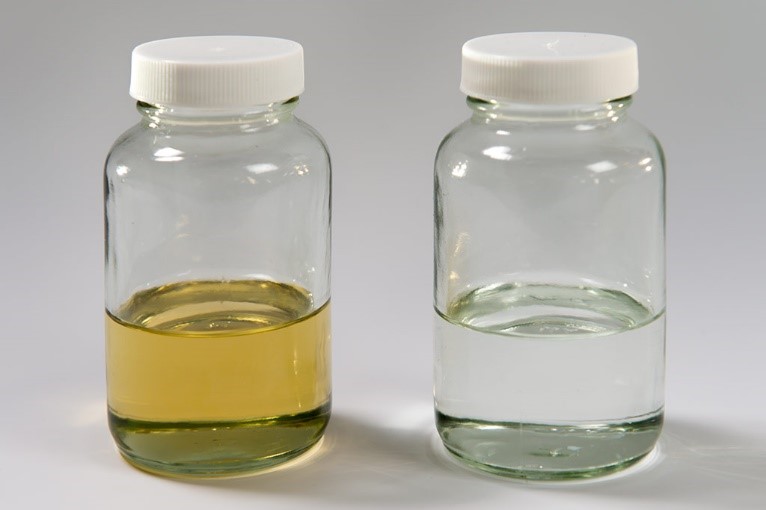
Jet fuel designed for use in aircraft powered by gas-turbine engines. It is clear to straw-colored in appearance. The most commonly used fuels for commercial aviation are Jet A and Jet A-1 are produced to a standardized international specification.

Jet fuel is a mixture of a large number of different hydrocarbons. The range of their sizes is restricted by the requirements for the product, for example, the freezing point or smoke point. Kerosene-type jet fuel has a carbon number distribution between about 8 and 16 carbon numbers (carbon atoms per molecule); wide-cut or naphtha-type jet fuel (including Jet B), between about 5 and 15 carbon number.

Jet A-1 is the standard specification fuel used in the rest of the world. Jet A-1 has a flash point higher than 38 °C (100 °F), with an autoignition temperature of 210 °C (410 °F).
Description

PROPERTY LIMITS IP ASTM REMARKS
appearance
visual appearance clear, bright and visually free from solid matter and un-dissolved water at ambient fuel temperature
colour report d 156 or d 6045 see note 1
particulate contamination mg/l max 1.0 423 d 5452 see note 2
particulate, cumulative channel particle counts, iso code & individual channel counts 564 or 565 or 577 see note 3
≥ 4 μm(c) report
≥ 6 μm(c) report
≥ 14 μm(c) report
≥ 21 μm(c) report
≥ 25 μm(c) report
≥ 30 μm(c) report
composition
total acidity, mg koh/g max 0.015 354 d 3242 see note 4
aromatics, % v/v. max 25.0 156 d 1319
or total aromatics, % v/v max 26.5 436 d 6379 see note 5
sulphur, total, % m/m max 0.30 336 d 1266 or d 2622 or d 4294 or d 5453
sulphur, mercaptan, % m/m max 0.0030 342 d 3227
or doctor test negative 30 d 4952 see note 6
refinery components at point of manufacture: see note 7
non hydroprocessed components, %v/v report (incl. ‘nil’ or ‘100%’)
mildly hydroprocessed components, % v/v report (incl. ‘nil’ or ‘100%’)
severely hydroprocessed components, % v/v report (incl. ‘nil’ or ‘100%’)
synthetic components, %v/v report (incl. ‘nil’ or ‘50%’) see note 4 for limits for synthetic components